
L'Italiana in Algeri (1957)
L'Italiana in Algeri (1957)
Couldn't load pickup availability
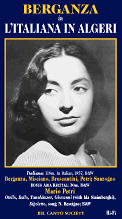
Berganza, Misciano, Bruscantini, Petri; Sanzogno. (1957). 118m. + Mario Petri Aria Recital. 30m. Otello, Ballo, Tannhäuser, Giovanni (with Ida Sinimberghi), Rigoletto, song; N. Rescigno. B&W
PAL VHS ONLY
Tully Potter, Reviewing in International Opera Collector:
“The Bel Canto Society video of L’italiana in Algeri is as close to perfection as we are likely to have. Filmed for Italian TV in 1957, it has a cast drawn from the best of the second generation of Rossini revivalists. Teresa Berganza was only 22 but has never done anything better, though she may have equalled her portrayal of the determined young Isabella. The role suits her in every way and vocally she is in total command. The menacing looking Mario Petri sings Mustafà, as he did on the brutally butchered Giulini recording. This is a much fuller edition, sparklingly conducted by the underrated Nino Sanzogno–the traditional loss of Mustafà’s aria is the only major cut. Taddeo is Sesto Bruscantini, greatest comic bass-baritone of the century and, like Petri, able to bounce his lower notes about like a rubber ball; his visual comedy is brilliantly timed and mimed. Alvinio Misciano, here in his proper métier of lyric tenor, is a Lindoro who can manage his tricky aria with ease–rather better than the horn soloist. He is also a fine actor. The rest of the cast is equally carefully selected, down to the Zulma of Vittoria Palombini. There is much hilarious dancing about, as well as comic business with a dwarf which would be politically incorrect today. One or two tiny breaks in the film do not affect the general delight. The soundtrack is fine–I have long treasured the LPs and then the CDs. As a bonus on an already desirable tape, we are given half an hour of Petri singing arias, from a TV recital.”
Stefan Zucker:
Mezzo-soprano vocal personalities and voices typically are assertive. But Berganza, as in this performance, given when she was only 22, is feminine and girlish. A mezzo by the name of Theresa Treadway brought out Isabella’s eroticism very effectively by, among other things, undulating her hips. Berganza, by contrast, bewitches through understatement. Yet she has enough power for assertion, as in the phrase “Una donna t’insegna ad esser forte,” which she sings an octave lower than written, with chest resonance, for added emphasis. When the time comes to rally the Italians, in “Pensa alla patria,” she unleashes the fullness of her voice.
Voices as a rule tend to become more weighty with age. (Tauber’s is the usual counterexample, and there are others.) Here Berganza’s voice is fuller than 10 or 20 years later. By the time of her performances of Cenerentola in 1958, her sound suggested that it almost might have become suitable for Amneris and Azucena, but a few years later her voice shed some pounds.
Already at this stage of her career she has some vitality of musical phrasing, as when she causes accentuations to emerge from crescendos and underscores dissonances and deemphasizes their resolutions.
Mario Petri (January 22, 1922, Perugia — January 26, 1985, Città della Pieve, near Perugia) made his Scala debut in 1947. Among his roles there were Leporello, Giovanni, the Count in Figaro, Bluebeard and Creonte (Oedipus Rex).
Glyndebourne and Edinburgh witnessed his Giovanni, Salzburg his Pistol. In 1949 he sang in the world premiere of Pizzetti’s Vanna Lupa in Florence. Some of his other appearances were in Florence in Medea with Callas, at the Verona Arena and in the opera houses of Parma, Turin, Bergamo and Naples. He recorded for Cetra, HMV, Harmonia Mundi and Ricordi.