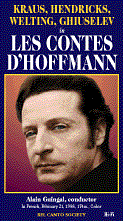

Les Contes d'Hoffmann
Les Contes d'Hoffmann
Couldn't load pickup availability
(The Tales of Hoffmann)
Kraus, R. Welting, Hendricks, Ghiuselev; Guingal. In French, no subtitles. (1988). 174m. Color.
PAL VHS ONLY
Kraus: “I lament the absence of three titles from my recorded legacy: Les Contes d’Hoffmann, Faust, Elisir.”
“Kraus is an artist capable of amazing us today, even more than several years ago, for his ability to manage his voice with the utmost ease, even on the most perilous high notes, or in those moments when the director has imposed scenic acrobatics inappropriate, not to say foolhardy, for one of his considerable years. But, besides the phenomenon, Kraus remains an authentic artist, the last example of an extinct style, who, for his refinement of phrasing, exquisite nuances, and elegance of delivery, makes us already regret the inevitable leavetaking. And there is a sadness at the final bow, which we wish would never be the last, of this legendary artist, which prevails at each of his triumphs, as this unforgettable performance, wildly acclaimed by the audience, reminds us.”–Davide Annachini, “The Eternal Charm of Kraus,” La Città, February 26, 1988
“Alfredo Kraus is here amazing for his scenic agility, expressivity and irony but above all for his clarion tones, aristocratic phrasing and intensity combined with purity of sound. His ‘Ballad of Kleinzach’ is a model in its progression from the strophic character of the chanson to the arioso evoking the trois femmes dans la même femme. In the mordant spirit of the ballad, Kraus springs onto the table like a 20-year-old and closes with incredible aplomb while the theater explodes in applause.”–Gianni Gori, “Labyrinth of Emotions,” Il Piccolo, February 15, 1988
“The initial wonder of the evening was the way in which Kraus made this character his own, from his first appearance in Luther’s tavern, and the wealth of vocal and dramatic elements with which he rendered vibrant and volatile a figure who could otherwise fall into the stereotype of the disillusioned lover. In recent years, when Kraus is spoken of in these parts, the emphasis is usually on his style, the result of an extraordinary ability to manage his resources in the struggle against time. But this evening the inevitable admiration of this supreme example of skill took second place in the face of the more vivid emotion conveyed by the character of Hoffmann, brought to life by Kraus with elegance, perfection of pronunciation and sensuous shaping of the musical phrase, with controlled passion that revealed a miraculous oneness with his character.”–Gian Paolo Minardi, “Better to Love Poetry Than a Doll,” La Gazzetta, February 15, 1988
Kraus is severe and often wears a pained expression, but when the audience goes wild after he interpolates a C in the “Kleinzach” aria, he relents and actually smiles! The audience is just as enthusiastic about Welting’s Olympia and Hendricks’s Antonia. Kraus interpolates more high Cs; still, the performance serves the music. Hoffmann fans: pounce. Gorgeous print, stereo. (The tape may be heard in stereo only on Hi-Fi VCRs.)–Stefan Zucker